


WikiRacing
 Racing
Racecourses
The six courses: their shapes, way round, home straights, gradients, surfaces and scenery, with maps.
There are 6 racecourses, and no two race alike. Each has its own shape, its own way round, its own home straight and its own scenery on the broadcast. Every race names its course on the racecard, and the race viewer shows a small overhead course map with the field moving round it.
At a glance
| Course | Shape | Way round | Lap | Home straight | Finish | Surfaces |
|---|---|---|---|---|---|---|
| Ashcombe | Oval | Right-handed | 2,400 m | 500 m | Flat | Turf, Dirt |
| Kestrel Downs | Triangle | Left-handed | 1,800 m | 280 m | Flat | Turf, Synthetic |
| Saltmarsh | Oval | Left-handed | 2,800 m | 800 m | Flat | Turf |
| Bellmont | Oval | Left-handed | 2,000 m | 450 m | Flat | Dirt, Synthetic, Turf |
| Larkspur | Pear | Right-handed | 2,200 m | 550 m | Downhill 0.5% to the line | Turf, Dirt |
| Harrowgate | Horseshoe | Right-handed | 2,600 m | 450 m | Uphill 3.5% to the line | Turf, Dirt |
A left-handed course turns left all the way round (anticlockwise seen from above); a right-handed one turns right. The home straight runs from the last bend to the winning post: a long one gives late finishers time to come through, a short one with tight bends favours horses that lead early and hold a good position on the rail.
The six courses
Ashcombe
A wide, fair parkland oval: no tricks, the best horse usually wins.

Ashcombe by the numbers live from the rules
- Way round
- Right-handed (clockwise)
- One lap
- 2,400 m (12f)
- Home straight
- 500 m
- Bends
- Sweeping
- Finish
- Flat
- Surfaces
- Turf, Dirt
- Scenery
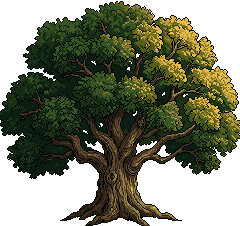
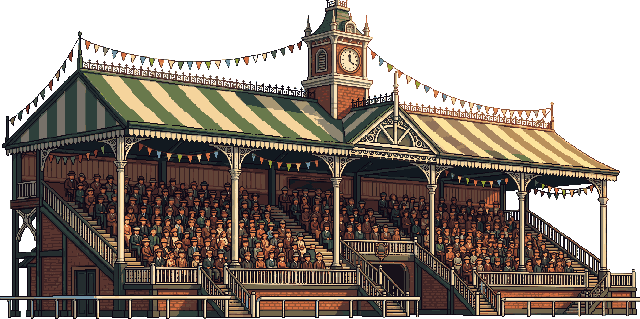
- Parkland: old oaks and poplars, a Victorian grandstand with a striped roof
Kestrel Downs
Tight and turning on the chalk: front-runners and low draws are hard to pass.

Kestrel Downs by the numbers live from the rules
- Way round
- Left-handed (anticlockwise)
- One lap
- 1,800 m (9f)
- Home straight
- 280 m
- Bends
- Tight
- Finish
- Flat
- Surfaces
- Turf, Synthetic
- Scenery
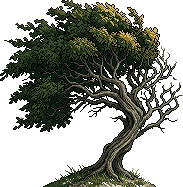
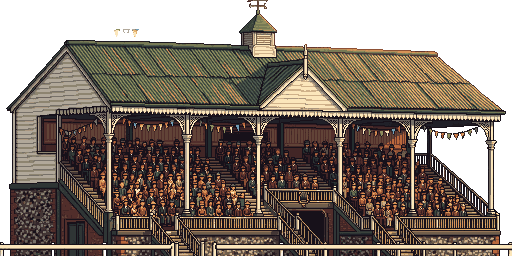
- Chalk downs: rolling downland with a white horse cut into the hill, windswept thorns and gorse
Saltmarsh
A long, galloping coastal track with the longest straight: closers come late.

Saltmarsh by the numbers live from the rules
- Way round
- Left-handed (anticlockwise)
- One lap
- 2,800 m (14f)
- Home straight
- 800 m
- Bends
- Sweeping
- Finish
- Flat
- Surfaces
- Turf
- Scenery
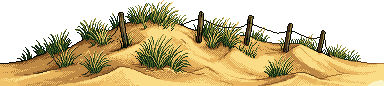
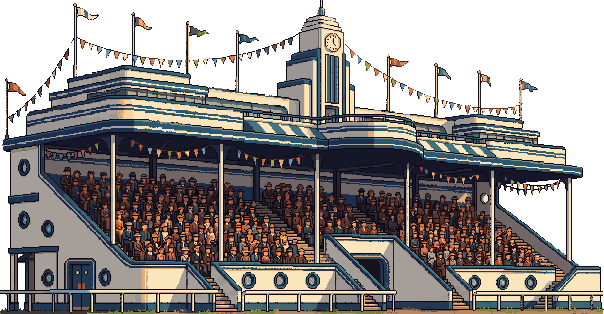
- Coast: the open sea and a lighthouse, sand dunes, beach huts and an Art Deco stand
Bellmont
A flat, fast city track: speed and an even pace.

Bellmont by the numbers live from the rules
- Way round
- Left-handed (anticlockwise)
- One lap
- 2,000 m (10f)
- Home straight
- 450 m
- Bends
- Medium
- Finish
- Flat
- Surfaces
- Dirt, Synthetic, Turf
- Scenery
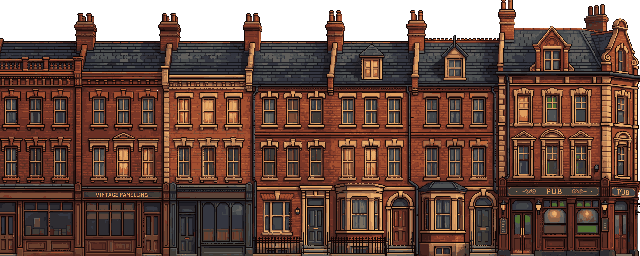
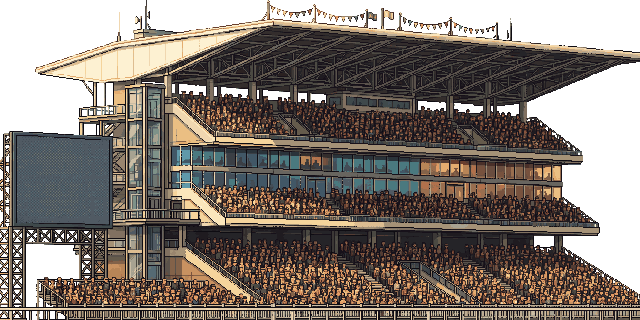
- City: a skyline of towers and spires, terraced streets and a steel-and-glass stand
Larkspur
A gentle meadow pear-shape, slightly downhill home: quick times on fast ground.


Larkspur by the numbers live from the rules
- Way round
- Right-handed (clockwise)
- One lap
- 2,200 m (11f)
- Home straight
- 550 m
- Bends
- Wide
- Finish
- Downhill 0.5% to the line
- Surfaces
- Turf, Dirt
- Scenery
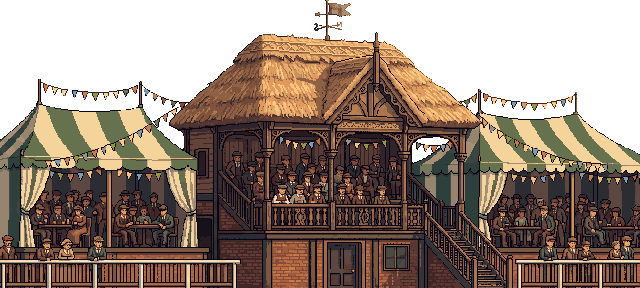
- Meadow: wildflowers, weeping willows, a windmill and a thatched pavilion with marquees
Harrowgate
A stiff moorland horseshoe with an uphill finish: a true test of stamina.

Harrowgate by the numbers live from the rules
- Way round
- Right-handed (clockwise)
- One lap
- 2,600 m (13f)
- Home straight
- 450 m
- Bends
- Wide
- Finish
- Uphill 3.5% to the line
- Surfaces
- Turf, Dirt
- Scenery
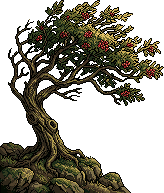
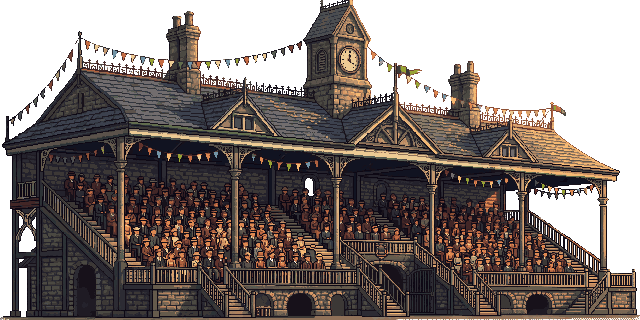
- Moorland: heather moors and granite tors, dry-stone walls and a millstone grandstand
Reading the course map
The course map sits in the corner of the race broadcast (tap its title bar to fold it away on a phone) and next to the race name on the racecard. It is drawn from the same course definitions as everything else:
- The outline is the course seen from above, with a small brass arrow showing the way the horses run.
- The red and white bar is the winning post, at the end of the home straight along the bottom.
- The green bar is where this race starts. A race longer than one lap starts further round and passes the post on the way.
- An amber stretch before the post is an uphill finish (blue would be downhill); during the race a ▲ Uphill flag shows while the leaders are on it.
- In the race, each runner is a dot in its silks colour. The leader has a brass frame and your own horse a white one. The dots only ever show what the broadcast has already shown, so a live race is never spoiled.
What suits where
A course tilts a race towards a type of horse; it never decides it. The best horse on the day still usually wins, but it is worth matching your runner to the track when you enter a race:
- Saltmarsh has the longest straight (800 m): time for closers to come from behind.
- Kestrel Downs has the tightest bends: front-runners and low draws are hard to pass.
- Harrowgate climbs 3.5% over the final stretch: stamina tells at the end. On the broadcast you see the field run uphill to the post.
- The weather and the going still apply on top of the course: see how races are run.