


WikiYour horses
 Your horses
Injuries
Every named injury by severity, where it is, how long it takes and what makes it likelier.
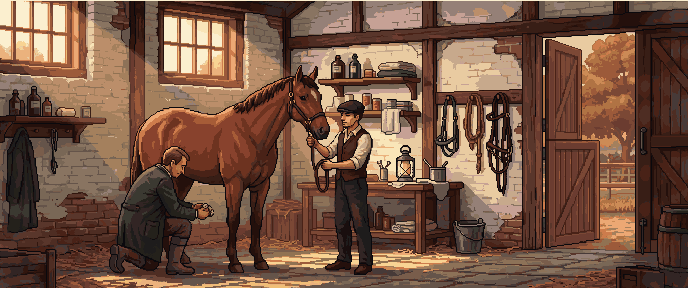
Racehorses get hurt the way real racehorses do: sore shins on firm ground, a strained tendon at the end of a long, tiring race, a bruised foot from a stone. Every injury in the game has a name, a place on the horse and a typical recovery time. Most are minor. A few end a racing career, and in Live races a very few are fatal.
Every injury, by severity
The game first decides whether a horse is hurt and how badly, exactly as described in Injuries & insurance. Then it names the injury: one of the injuries of that severity that heal in that time, picked with the context of the race in mind. The name never changes the chance of being hurt or how long it takes to heal.
Minor injuries
A few days off, then back to racing.
| Injury | Likelier with |
|---|---|
| Sore shinsFront leg · 3 to 4 daysBucked shins: tender, inflamed shin bones from fast work, common in young horses. | firm going, sprints (1,400 m or less) |
| Bruised footFoot · 2 to 3 daysA bruise to the sole of the hoof from hard ground or a stone; sore for a few days. | firm going |
| Overreach cutFront leg · 2 to 3 daysA hind hoof clipped the back of a front heel and left a small cut. | soft or heavy going, racing or working tired |
| Mild tying-upBack and hindquarters · 2 to 3 daysStiff, cramped muscles over the back and quarters after effort; eases with rest. | racing or working tired, deep ground when tired, long trips (over 2,400 m) |
| Lost shoe and a bruiseFoot · 2 daysA shoe came off in running and the hoof wall is bruised until the farrier re-shoes it. | soft or heavy going (heavy most) |
| Knocked jointHind leg · 2 to 4 daysA bump to a fetlock or hock in the race; a little swelling that settles. | nothing in particular: bad luck in running |
Moderate injuries
A longer box rest, then back to racing.
| Injury | Likelier with |
|---|---|
| Tendon strainFront leg · 8 to 12 daysMild strain of a flexor tendon behind the cannon; heat and swelling that need box rest. | soft or heavy going, racing or working tired, an all-out ride, fragile legs, long trips (over 2,400 m) |
| Foot abscessFoot · 6 to 9 daysAn infection trapped inside the hoof; lame until it is drained and poulticed. | soft or heavy going (heavy most) |
| Hairline fractureFront leg · 9 to 12 daysA fine stress crack in the cannon bone; it knits with rest and slow work. | firm going, fragile legs, an all-out ride, sprints (1,400 m or less) |
| Back strainBack and hindquarters · 6 to 10 daysA sore sacroiliac or back muscles from slipping or pulling hard; needs rest and physio. | heavy going, deep ground when tired, racing or working tired |
| Splint injuryFront leg · 6 to 9 daysInflammation of a small splint bone beside the cannon; it firms up with rest. | firm going, sprints (1,400 m or less) |
| Bled from the lungs (mild)Heart and lungs · 6 to 8 daysA little bleeding in the lungs under hard effort (EIPH); a short break lets them settle. | an all-out ride, long trips (over 2,400 m), racing or working tired |
Career-ending injuries
The horse can't race again. These heal well enough for a comfortable life: stud, the broodmare band or the Legacy Farm.
| Injury | Likelier with |
|---|---|
| Bowed tendonFront leg · 16 to 21 daysA badly torn flexor tendon that bows the back of the leg; sound for a quiet life, not for racing. | soft or heavy going, racing or working tired, an all-out ride, fragile legs, long trips (over 2,400 m) |
| Suspensory ligament injuryFront leg · 15 to 21 daysA torn suspensory ligament, the sling that holds up the fetlock; it heals, but not for racing. | soft or heavy going (heavy most), racing or working tired, long trips (over 2,400 m) |
| Sesamoid fractureFront leg · 16 to 21 daysA break in one of the small bones at the back of the fetlock; repaired for a comfortable retirement. | firm going, fragile legs, an all-out ride, racing or working tired |
| Condylar fractureFront leg · 18 to 21 daysA fracture at the lower end of the cannon bone, usually repaired with screws; retired sound for pasture or stud. | firm going, fragile legs, an all-out ride, sprints (1,400 m or less) |
| Chronic joint damageFront leg · 14 to 17 daysWorn cartilage and arthritic changes in a knee or fetlock; comfortable at pasture, not in a race. | veteran legs, firm going |
| Severe recurrent bleedingHeart and lungs · 14 to 16 daysHeavy bleeding from the lungs that keeps coming back under race effort; fine for a quiet life. | long trips (over 2,400 m), an all-out ride |
Fatal injuries
Live races only, never Story races or training. Rare, and written about calmly.
| Injury | Likelier with |
|---|---|
| Catastrophic leg fractureFront legA breakdown: a leg fracture that could not be repaired. The vets put the horse's welfare first. | fragile legs, firm going, an all-out ride, racing or working tired |
| Sudden heart failureHeart and lungsThe heart failed suddenly during the race. It happens without warning, even to sound horses. | long trips (over 2,400 m), an all-out ride |
| Severe bleeding from the lungsHeart and lungsA sudden, severe haemorrhage in the lungs under race effort. | an all-out ride, long trips (over 2,400 m) |
What makes one injury likelier than another
The race itself shapes which injury it is, if one happens:
- Firm going: sore shins, bruised feet, splints and fractures.
- Soft or heavy going: tendon and suspensory strains, foot abscesses and lost shoes.
- Long trips (over 2,400 m) and tiredness: tying-up, tendon trouble and bleeding from the lungs.
- Sprints (1,400 m or less): sore shins and splints.
- An all-out ride: tendons and fractures. Fragile legs: fractures and tendons. Veteran legs: chronic joint damage.
- Deep ground when tired: tying-up and back strain.
| Context | Likeliest minor | Likeliest moderate | Likeliest career-ending |
|---|---|---|---|
| Good going, 1,600 m, normal ride | Knocked joint (28%) | Tendon strain (30%) | Suspensory ligament injury (24%) |
| Firm going, 1,200 m sprint | Sore shins (41%) | Hairline fracture (28%) | Sesamoid fracture (21%) |
| Heavy going, tired, 2,800 m | Mild tying-up (32%) | Tendon strain (41%) | Suspensory ligament injury (37%) |
| All-out ride, fragile legs | Knocked joint (28%) | Tendon strain (35%) | Bowed tendon (28%) |
| A veteran on firm going | Sore shins (34%) | Hairline fracture (25%) | Chronic joint damage (27%) |
How the risk works
Every rated start begins from 0.4%. These factors multiply it, up to a ceiling of 8%:
- Durability: from ×1.6 for the most fragile type to ×0.6 for the soundest.
- Fatigue: above 30% fatigue, up to ×3 when exhausted.
- Frequency: +0.4 for each run already today, +0.1 for each run over 6 in a week.
- Going: firm ×1.3, good ×1.0, soft ×1.1, heavy ×1.4 (shoes for the going halve the extra).
- The ride: conservative ×0.7, normal ×1.0, all-out ×1.5.
- Distance: ×1.1 over 2,400 m. Veteran legs: ×1.2. Fragile legs: ×1.3. Iron legs: ×0.8. Pre-race vet check: ×0.75.
If an injury happens, it is career-ending 3% of the time at baseline; more if the horse was very tired (over 70% fatigue, +3%) or ridden all-out (+2%). Of the rest, 30% are moderate and 70% minor. Training only ever causes minor knocks, and only when a tired horse is worked hard.
Career-ending and fatal injuries
- A career-ending injury retires the horse from racing at once. It still heals (14 to 21 days), and after that a mare can join your broodmares and a stallion can stand at stud, or the horse can retire to the Legacy Farm. If it was insured, the insurance pays.
- A fatal injury happens only in Live races: 20% of career-ending injuries there. Story races, trials and training are never fatal. The horse rests on the Legacy Farm in memoriam, its record stays in your books and the Hall, and any foals carry the line on. See The Legacy Farm.
Fragile legs run in families
A horse whose racing ended in an injury can pass fragile legs to its foals: 50% of the time for each such parent, and a fragile parent passes its own gene as well. Fragile legs cost 100 durability potential and multiply the injury risk by 1.3, and make fractures and tendon injuries the likelier kinds. See Fragile legs.
Healing: rest, care and the vet
Healing runs in real time, even while you are away. You can speed it up:
What helps live from the rules
- Rest
- Every real hour heals an hour
- A care session (once a day)
- 12 hours off
- Vet treatment (once a day)
- 24 hours off, 150 credits
- The Vet facility
- Each level makes an hour of healing count 25% more
The horse page shows the injury by name, where it is, what it is and how long until it heals. Days and costs for each vet level are worked out in Injuries & insurance.
Mares in foal don’t race
A mare carrying a foal can’t be entered in a race. The other way round, a mare entered in a race that hasn’t run yet can’t be covered: scratch her while entries are open, or cover her after the race. The horse page and the entry sheet show “In foal · can race again after foaling (in N h)”; a pregnancy lasts 24 hours. See Stud & broodmares.