


WikiYour horses
 Your horses
Growing up
From foal to veteran: life stages, care to racing age and the peak window.
A horse grows up on its own clock, not the calendar. A youngster moves on with each day you care for it; a racehorse moves on with each start. Nothing ages while you are away, so a foal left alone for a month is still the same foal, waiting for you.
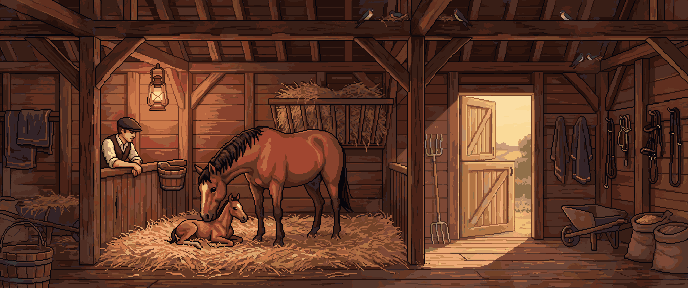
The life stages
| Stage | Reached by | What it can do |
|---|---|---|
| Foal | Being born | Grow. No training, no racing. |
| Weanling | 5 care sessions | Grow. Still too young to train. |
| Yearling | 12 care sessions | Light training only, at half the usual effect. |
| Juvenile | 19 care sessions (racing age) | Race. Juvenile until 6 starts. |
| Prime | 7 starts | The heart of the career, to 28 starts. |
| Veteran | 29 starts | Still racing, with slightly higher injury risk, until 40 starts. |
After 40 starts (or earlier, if you choose or an injury ends it) the racing career is over. A horse can then go to stud or become a broodmare while it has breedings left, or retire for good to the Legacy Farm. See The racing career and Stud & broodmares.
By the numbers live from the rules
- Care sessions to wean
- 5
- Care sessions to yearling
- 12
- Care sessions to racing age
- 19
- Juvenile
- 0 to 6 starts
- Prime
- 7 to 28 starts
- Veteran
- 29 to 40 starts
From foal to racing age
Each counted care session moves a youngster one step on. You get one counted session per horse per day, so a newborn foal needs at least 19 days of care to reach racing age. Miss a day and growth simply waits. Its body fills out as it grows: a newborn shows about 30% of its potential, and gains evenly with each session up to its racing-age level.
Coats can change too. A grey is born coloured, races dappled, and goes grey as its career goes on:



Maturity and the peak window
Genes give every horse a maturity type. It decides when, in starts, the horse reaches its full potential, and how long it stays there. Before the window the horse is still improving; after it, it slowly loses a little, speed first.
| Type | Peak window | At racing age | At the last start | In short |
|---|---|---|---|---|
| Early peaker | starts 6 to 18 | 90% | 89% | Comes to hand quickly and is at its best in the first half of its career. |
| Normal maturity | starts 10 to 28 | 86% | 93% | Peaks through the middle of its career. |
| Late developer | starts 16 to 34 | 81% | 95% | Keeps improving and is at its best later in its career. |
Share of potential at each start, 0 to 40
Brass bars: the peak window. Worked out by the game’s own maturity curve when this page is built.
Not every stat peaks at once
Each stat’s window is nudged from the horse’s own: Speed 2 starts early, Stamina 3 starts late, Burst 2 starts early, Durability on time, Adaptability 3 starts late, Temperament 2 starts late. Speed and burst come first; stamina, adaptability and temperament keep building.
The nursery
Every horse not yet at racing age shows in the Nursery, with its care progress and what is known so far about its potential. Foals arrive from your own mares, from Paddock Packs and, on your second day, as a gift from the Club.
- A foal needs a stall. If the stalls are full it waits in the nursery overflow slot, and moves in as soon as a stall frees up.
- Its potential shows as a range that narrows at each stage and with every start. A Pedigree Scan narrows it for good. See Genetics & inheritance.
- When the last care session is done, the youngster appears under Ready to race. Tap Welcome to the yard and it joins your racing string.
- A stable hand from Facilities cares for every horse in one tap.
Day-to-day care is covered in Care & condition.