


WikiRacing
 Racing
How races are run
The race engine, close finishes, form on the day, handicap weights, improvers, sealed seeds, replays you can verify and what-if re-runs.
Every race in Post Time is run by the same race engine: a step-by-step simulation of the horses, their stamina, their kick and the traffic around them. It has no hidden hand. The result is decided by the horses and one secret number, the race’s seed, which is locked in before the off and published afterwards so anyone can check it.
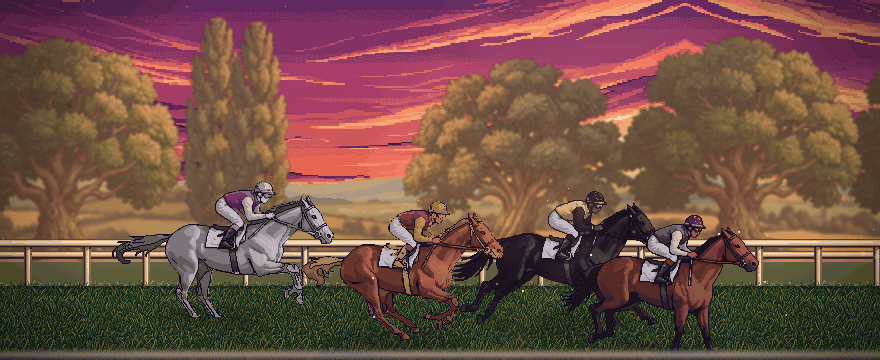
The race engine
The engine moves every horse forward 20 times a second of race time. Each horse runs from the stats it brought to the race: its speed, stamina and burst, adjusted for its condition, the trip, the surface and the going, plus its tactic. Front-runners go for the lead, stalkers sit just behind, closers save energy for one late run. Horses that go too fast too early run out of energy, horses stuck behind others have to find a way round, and the ones on the wide outside cover more ground.
The engine is deterministic: given the same field and the same seed it produces exactly the same race, down to every frame and every hundredth of a second, on any computer. It uses whole-number maths only, so there is no rounding that could differ between machines. The seed supplies the small doses of luck a real race has: who breaks well, who gets a gap.
Every course races differently
Live races are run on one of 6 racecourses, and the engine knows each one’s shape: how tight its bends are, how long the run from the last bend to the post is, and whether the finish climbs or falls. The course is laid out back from the winning post, so a race’s trip decides how many bends it runs. A course tilts a race towards a type of horse; it never decides it, and the best horse still usually wins anywhere.
- Bends. A horse racing wide covers extra ground round a bend: on the tightest bend up to 5.0 metres for every lane out from the rail over a half-turn. Passing is harder while turning too (up to 40% fewer tries to switch out). Front-runners on the rail and horses drawn low gain on tight courses; a closer making its run round the turn loses.
- The home straight. A long straight gives a finishing kick room: a horse kicking down it spends 6% less energy for every 100 metres of straight over 500 m (at most 20%), and more on a shorter one. Closers, whose run is the longest, like long straights; on a short one it pays to be handy.
- An uphill finish costs energy all the way up the straight (2.5% more for each 0.1% of rise, for a horse of average stamina), and the less stamina a horse has the more it pays: stayers come into their own. A slight downhill saves energy instead, which suits the speedier, shorter-winded horses.
- Left- or right-handed is only how the course looks: no horse prefers a way round.
| Course | Bends | Home straight | Finish | Character |
|---|---|---|---|---|
| Ashcombe | Sweeping (15%) | 500 m | Flat | A wide, fair parkland oval: no tricks, the best horse usually wins. |
| Kestrel Downs | Very tight (90%) | 280 m | Flat | Tight and turning on the chalk: front-runners and low draws are hard to pass. |
| Saltmarsh | Sweeping (20%) | 800 m | Flat | A long, galloping coastal track with the longest straight: closers come late. |
| Bellmont | Tight (50%) | 450 m | Flat | A flat, fast city track: speed and an even pace. |
| Larkspur | Fair (40%) | 550 m | Downhill 0.5% | A gentle meadow pear-shape, slightly downhill home: quick times on fast ground. |
| Harrowgate | Fair (40%) | 450 m | Uphill 3.5% | A stiff moorland horseshoe with an uphill finish: a true test of stamina. |
The course’s shape is locked into the field with the runners when entries close, and sealed into the result hash with the seed, so it can’t change after the off. Story races, the Daily Cup and races run before courses raced differently have no course character.
Close finishes
Real races are rarely processions, and Post Time’s aren’t either. Two things in the engine keep evenly matched horses together to the line, so a narrow win, or a narrow defeat you can hope to turn round next time, is common. Neither looks at who owns a horse: they apply to every runner alike.
- Racing in a pack. Until a horse starts its finishing run, its pace is pulled 50% of the way towards the average pace of the field. A slightly slower horse is carried along in the slipstream (only 50% of the extra effort costs it energy); a faster one is held up by the pace and saves a little for later. The field stays together instead of stringing out from the start, and the best horse shows it where it matters: at the finish.
- A battle to the line. From the start of its finishing run (or the last 400 m), a horse with a rival up to 1.5 lengths ahead to run down, or one within 1.0 length behind to hold off, finds more: about 0.15 m/s, plus up to 0.10 m/s more the more composed it is (a genuine horse fights harder), plus up to 0.15 m/s of fight on the day that nobody knows in advance. That effort doesn’t drain its tank. So when two horses come to the last furlong together they usually stay together, and which one finds most decides it.
Form on the day
No horse runs to exactly the same level every time. Before each race the seed gives every runner its form on the day, a small rise or fall in its cruising pace, so a horse a few points below the best in the field still wins its share. Composed horses (high temperament) vary less; rain makes every horse vary a little more; a hired jockey keeps the run closer to the horse’s true level. In Live races the swing is 85% of what it was before close finishes came in, because the pack would otherwise turn it into too many upsets: a horse 7 points of rating below a rival still beats it about one time in three, and one 15 points below the best in an eight-runner field wins rarely.
In a Live handicap the better horses carry more weight: the top-rated runner carries 10st 0lb, and each of the others 1 lb less for every point of rating below it (never under 8st 0lb). Every pound costs a horse one point of rating’s worth of ability, so on the ratings the weights put the whole field level, and handicaps finish closest of all. The weights are printed on the racecard when entries close.
Improvement
Horses improve as they mature (see the maturity type on a horse’s career page) and with training. Some go further: about one horse in five is an improver (30% of late developers, 20% of normal ones, 15% of early types). At a point in its career that nobody can see coming, an improver steps up 4-8 points of rating’s worth of ability over 3 runs and keeps it, filling out its genes sooner (never beyond its potential). The career page shows Improving once it has happened. Who improves is fixed for each horse and is the same whoever owns it; races already run are never changed.
Sealed before the off
- When a race is put on the card, the game draws its secret seed and publishes only its fingerprint (a sha256 hash). The seed itself stays secret.
- When entries close, the field is locked: every horse’s race-day snapshot and tactic is stored, and the gates are drawn from the seed.
- At the off, the engine runs the race from the locked field and the seed. The broadcast shows it as it happens; nobody receives the result before it is shown.
- After the finish the seed is revealed with the result and its result hash, a fingerprint of the finishing order and times.
- Press Verify on the race page: the game re-runs the race from the field and the seed and checks it gets the same result hash, and your own browser hashes the seed and checks it matches the fingerprint published before the off.
A real race, run on this page
This race was run by the game’s own engine while this page was built: eight Club horses over 1,600 m on good turf at Ashcombe. Run it again with the same seed and you get the same result every time.
| Pos. | Horse | Gate | Tactic | Time | Beaten by |
|---|---|---|---|---|---|
| 1 | Lucky Promise | 2 | Stalker | 1:38.35 | Winner |
| 2 | Golden Rumour | 8 | Closer | 1:38.51 | 1 |
| 3 | Iron Tide | 7 | Stalker | 1:38.64 | 3/4 |
| 4 | Morning Gale | 3 | Closer | 1:38.99 | 2 1/2 |
| 5 | Copper Arrow | 5 | Front-runner | 1:39.22 | 1 3/4 |
| 6 | Silver Comet | 1 | Front-runner | 1:39.26 | head |
| 7 | Iron Ember | 4 | Stalker | 1:39.37 | 3/4 |
| 8 | Wild Lark | 6 | Closer | 1:39.74 | 2 1/2 |
This race's seal live from the rules
- Fingerprint (published before the off)
7ca7280e…e3309bda- Seed (revealed after the finish)
a51a1ae1…bcd1fdb4- Result hash
95022568…913bd77f- Re-run and checked
- Yes: same result, frame for frame
- Same race, runners listed in another order
- Same result
- Photo finish
- No
- Engine version
- 1.4.0
Margins and the photo finish
Each horse is timed to the line and placed by its time. The margin to the horse in front is called the racing way: a nose, a short head, a head, a neck, then lengths. A length here is 2.4 metres.
| Gap to the horse ahead | Called |
|---|---|
| 0.10 m | nose |
| 0.30 m | short head |
| 0.60 m | head |
| 1.00 m | neck |
| 1.20 m | 1/2 |
| 2.40 m | 1 |
| 7.20 m | 3 |
| 48.00 m | a distance |
When the first two are less than 15 centimetres apart, the race is a photo finish and the commentary calls for the photograph. There are no dead heats: the engine always puts one horse ahead of the other. Winning one earns the “By a Nose” plaque in your Trophy Room.
Replays
Because a race is fully described by its field and its seed, every settled race can be replayed exactly as it was run, from the race page, and shared. The replay is the race itself, not a recording of it: re-running it gives the same frames.
- A Live race’s result, seed and full replay are only released once the broadcast has shown the finish, so nobody can see a result early.
- A purse is split 55% / 20% / 12% / 7% / 4% / 2% among the first 6. See Race types.
- The Daily Cup uses the same engine and the same sealing, with one seed for the whole day: The Daily Cup.
What if? re-runs
Because a race is its field plus its seed, a race that has been run can be run again with one thing changed, and everything else stays exactly as it was: the same runners in the same gates, the same course and going, the same race model and the same sealed seed. Every horse’s luck (its form on the day, its break from the stalls, its pace and its fight) is drawn from that seed for its own gate, so it is the same luck as on the day. Only your change can move the result.
- Open a race your horse ran (the race page once the result is in, or a settled line in your form book) and tap What if?
- Pick one change to your own runner: the tactic, the ride (conservative, normal or all out), the race-day extras that act on the track (soft-ground shoes on soft or heavy going, a physio session), or the jockey (another of your jockeys, or a typical Club freelancer of a grade).
- See where you would have finished, how far behind the winner, the first five both ways and your horse’s sectionals both ways. Then watch the what-if in the viewer.
The rules live from the rules
- When
- Only once the race has been run and the result is official (the seed is revealed then): no peeking at a race to come.
- What can change
- One thing about your own runner. The other runners, the gates, the weights carried, the course, the going and the seed never change.
- Engine
- The race re-runs on the engine version it was run with, so an older race stays an older race. A change that race couldn't have had (a jockey before jockeys) isn't offered.
- Cost
- Free. 10 fresh re-runs an hour; one you've already run is free to look at again.
- Official?
- Never. No credits, no rating, no form line, no record: it's labelled “What if (not official)” everywhere it shows, and the replay has no photo finish or weighed-in.